
“It was like stepping back in time.” — Nigel Marven.

Click on the animals below to learn more about them.


Andrewsarchus was a large, carnivorous mammal that lived during the Eocene period, around 45 million years ago. With its wolf-like body, powerful jaws, and large teeth, it was one of the top predators of its time, known for its hunting prowess and scavenging habits.
Although its exact diet is still debated, Andrewsarchus likely hunted smaller mammals and may have scavenged carcasses, using its strong bite and keen senses to track down food. Its long, muscular legs and robust build allowed it to move quickly across the landscape in pursuit of prey or to protect itself from larger predators.
At Hoo Zoo, our Andrewsarchus helps visitors explore the evolution of early mammalian predators, the role of carnivores in prehistoric ecosystems, and how these early predators evolved to dominate their environments. Observing this fierce, ancient creature up close offers a chance to understand how predators shaped the landscapes of the past.

Daeodon is an extinct genus of entelodont even-toed ungulates that inhabited North America about 23 to 20 million years ago during the latest Oligocene and earliest Miocene. The type species is Daeodon shoshonensis, described by a very questionable holotype by Cope. Some authors synonymize it with Dinohyus hollandi and several other species (see below), but due to the lack of diagnostic material, this is questionable at best.

Titanis was a massive, flightless bird that roamed North America during the Miocene and Pliocene epochs, around 5 to 2 million years ago. Standing up to 10 feet tall, with powerful legs, sharp talons, and a fierce beak, it was a formidable predator in its time, resembling a giant version of modern-day ostriches and emus, but with the hunting skills of a bird of prey.
As a carnivore, Titanis hunted small mammals, reptiles, and possibly other birds. Its long legs allowed it to run at impressive speeds, while its talons and beak were ideal for grabbing and tearing into prey. Despite its inability to fly, Titanis was a dominant force in its ecosystem, using its agility and predatory instincts to catch and subdue its meals.
At Hoo Zoo, our Titanis offers visitors a chance to explore the world of prehistoric flightless birds, the evolution of terrestrial predators, and how these giants adapted to life without the ability to fly. Observing this towering predator up close gives visitors a glimpse into the fascinating world of giant birds that once ruled the Earth.
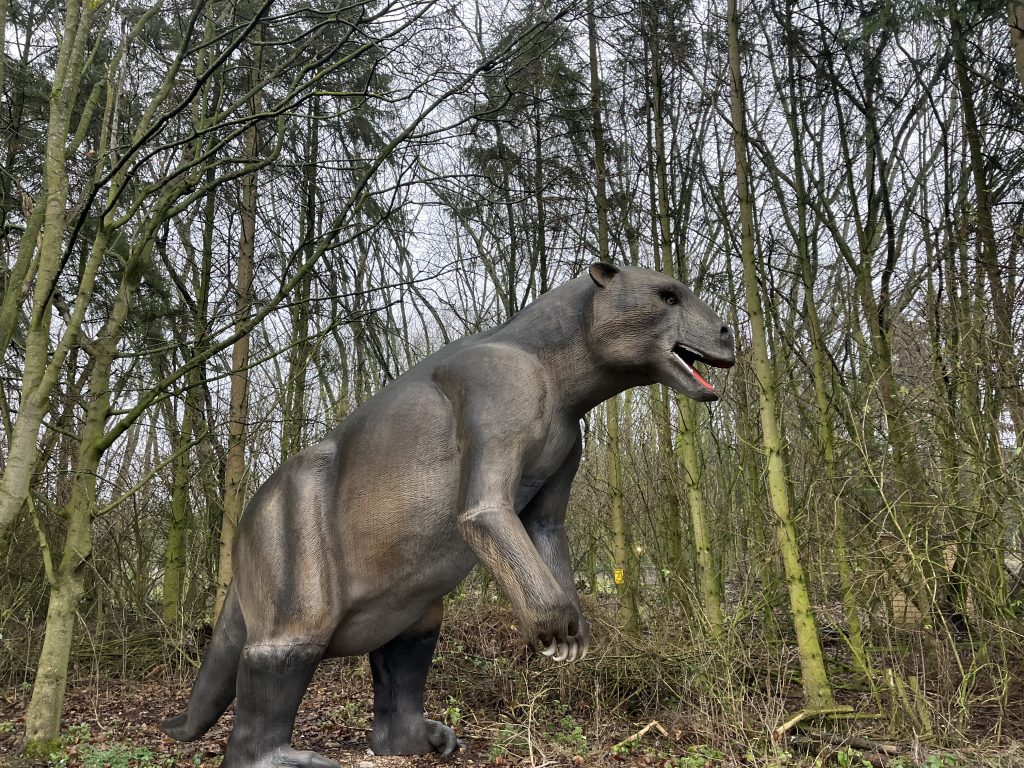
Megatherium was a giant ground sloth that lived during the Pleistocene epoch, around 10,000 years ago. With its enormous size—up to 20 feet long and weighing several tons—it was one of the largest land mammals of its time, slowly roaming the grasslands and forests of South America.
A herbivore, Megatherium fed on leaves, twigs, and shrubs, using its long, powerful claws to strip vegetation from trees and shrubs. Despite its massive size, it was surprisingly agile, able to rear up on its hind legs to reach high branches. Its thick fur and slow, deliberate movements helped it survive in a variety of climates, from open savannas to forests.
At Hoo Zoo, our Megatherium helps visitors explore the world of giant prehistoric mammals, the role of megafauna in shaping ecosystems, and how creatures of this size adapted to their environments. Observing this colossal creature up close gives visitors a chance to appreciate the sheer scale and unique behaviors of one of the most impressive mammals to ever roam the Earth.

Doedicurus was a massive, armoured mammal that lived during the Pleistocene epoch, around 10,000 years ago. Resembling a giant, prehistoric armadillo, it was protected by a thick, bony shell and long, spiked tail, making it one of the most uniquely defended creatures of its time.
A herbivore, Doedicurus fed on grasses and shrubs, using its strong limbs and claws to dig for plants or break through tough vegetation. Its armor—made up of large, overlapping plates—helped protect it from predators, while its tail, tipped with sharp spines, could be used as a defensive weapon to ward off attackers. This massive creature moved slowly but was well-equipped to survive in the harsh conditions of the Ice Age.
At Hoo Zoo, our Doedicurus helps visitors explore the world of prehistoric megafauna, the evolution of armor in mammals, and the unique ways ancient animals defended themselves. Observing this armoured giant up close gives visitors a chance to appreciate the remarkable adaptations that helped Doedicurus thrive in a world full of predators.

The Woolly Mammoth was a colossal, herbivorous mammal that roamed the northern parts of North America, Europe, and Asia during the Ice Age, up until around 4,000 years ago. With its long, curved tusks, thick, shaggy coat, and large, powerful body, it was perfectly adapted to survive the cold, harsh climates of the Pleistocene epoch.
Feeding on grasses, shrubs, and woody plants, the Woolly Mammoth used its tusks to forage for food, strip bark, and dig through the snow in search of vegetation. Its dense fur, layer of fat, and small ears helped it stay warm in freezing temperatures, while its strong legs allowed it to travel across vast, icy landscapes.
At Hoo Zoo, our Woolly Mammoth helps visitors explore the fascinating world of Ice Age megafauna, the role of large herbivores in shaping ecosystems, and how animals adapted to survive extreme cold. Observing this magnificent creature up close offers a chance to connect with the ancient past and appreciate how these incredible mammals once thrived in the wild.

The Cave Bear was a massive carnivorous bear that roamed Europe and parts of Asia during the Pleistocene, going extinct around 15,000 years ago. With its towering size and powerful build, it was one of the largest bears to ever live, known for its strength and adaptability in the cold, dark caves of its habitat.
A mostly herbivorous bear, the Cave Bear fed on grasses, berries, and shrubs, though it may have also hunted smaller animals. It used its massive claws and powerful jaws to forage, dig, and protect itself from predators or rivals. Cave Bears often sought shelter in caves, where their remains have been discovered, offering valuable insight into their lives and behaviour.
At Hoo Zoo, our Cave Bear helps visitors learn about the great megafauna of the Ice Age, the role of large predators in shaping ecosystems, and how these ancient creatures adapted to cold, harsh environments. Observing this powerful bear up close gives visitors a deeper understanding of one of the most impressive predators of the prehistoric world.

The Woolly Rhino was a large, herbivorous mammal that roamed the icy tundras of Eurasia during the Ice Age, living around 35,000 years ago. With its thick, shaggy coat, powerful horns, and massive frame, it was built to endure the frigid conditions of the Pleistocene.
Feeding on grasses, shrubs, and tough plants, the Woolly Rhino used its strong, curved horns to dig up vegetation and defend itself from predators. Its dense fur and layer of fat helped it survive in extreme cold, while its sturdy legs and broad feet allowed it to move across snow and ice. Despite its size, the Woolly Rhino was an agile grazer that played an important role in shaping the landscape.
At Hoo Zoo, our Woolly Rhino helps visitors explore the world of Ice Age megafauna, the adaptations that allowed these massive creatures to thrive in harsh climates, and the way herbivores influenced the ecosystems they lived in. Observing this mighty, ancient rhino up close gives visitors a chance to appreciate the strength and resilience of one of the Ice Age’s most iconic mammals.
Travel from 50 million years ago through dramatic climate change and evolution, right up to the Ice Age. Encounter incredible prehistoric mammals and learn how these powerful creatures shaped the planet in an immersive, walk-through experience that brings lost worlds roaring back to life.
Join our mailing list ot be the first to know about upcoming events!
To guarantee entry on the day, it’s essential that tickets are pre-booked. This can be done online through our ticketing system.

 Book Your Tickets


